Free Emergency Binder Printables (Autism-Ready, Three Designs)
Free emergency binder printables built for autistic children: a 10-page PDF with child ID, medical, communication, sensory, elopement, and safe foods pages. Fillable PDF and editable PowerPoint included, no email.
Key Takeaways
- This free emergency binder is built for autistic children, not adapted from a generic family binder: it carries communication, sensory, elopement, and safe foods pages that first responders and emergency caregivers will not find in any household binder template.
- Safety-critical information gets a high-contrast red ALERT treatment in every design: drawn-to-water risk, what to do in the first minutes a child is missing, allergies, and how to approach without escalating.
- Ten pages: cover, child ID, emergency contacts, medical information, communication, sensory profile, safety and elopement, safe foods, school and therapies, and a backup-caregiver plan with a review log.
- Every file is free with no email required, in three designs, in US Letter and A4. Each design also has a fillable PDF you can type into and an editable PowerPoint with every element as a real object.
- A binder only helps if the right people can reach it: print copies for home, the emergency caregiver, and school or therapy, and use the review log after any change to medications, school, or contacts.
A parent sent Spectrum Unlocked the emergency binder they had built by hand for their autistic son and asked for a version other families could use. Their reasoning stuck with us: every emergency binder template online organizes documents for adults, and not one of them tells a first responder that a nonspeaking child will follow you if you show him a picture card, or that he will bolt toward the retention pond behind the house, or that he will refuse every food in the shelter except five.
This is that binder, rebuilt as a free 10-page pack. Ten pages, three designs, US Letter and A4, fillable PDF and editable PowerPoint included, no email required:
- Cover with your child's name and photo spot
- Child ID: description, identifiers, and a current photo
- Emergency contacts in calling order, so a stranger knows who is next
- Medical information: medications, allergies, conditions, insurance
- Communication: how your child communicates and how to communicate back
- Sensory profile: triggers, warning signs, and what actually helps
- Safety and elopement: where they go, what draws them, the first-minutes plan
- Safe foods: what they will eat, what they will refuse, feeding notes
- School and therapies: where they are on a normal week, and who to call
- If I am not available: the backup-caregiver plan and a review log
Why a general family binder is not enough
Household emergency binders are document organizers. They hold insurance policies, account numbers, and copies of IDs, and they quietly assume that every member of the family can tell a helper what they need, follow spoken instructions, and eat whatever is handed to them.
For many autistic children those assumptions fail exactly when the stakes are highest. About half of autistic children elope at some point, and drowning is the leading cause of death in elopement cases, which is why the safety page in this binder asks specifically about water and where your child is drawn to go. The full elopement safety plan covers prevention in depth, and the elopement prevention guide covers the home setup; the binder is the piece of that plan a stranger can hold in their hands.
The communication page matters just as much. If your child uses an AAC device, gestures, or picture cards, the adult in front of them needs to know that in the first minute, not after the situation has already escalated. The sensory page does the same job for regulation: what overloads your child, what the early warning signs look like, and what helps, written down before anyone needs it.
The red pages are red on purpose
Safety-critical information carries a high-contrast ALERT treatment in every design: a red band you cannot skim past. Drawn-to-water risk, the if-missing steps for the first minutes, allergies, and how to approach your child without escalating all get it. A responder flipping through the binder under stress should be able to find the four things that cannot wait, and the visual design does that work for them.
The rest of each page is ordinary write-on lines, because the binder is meant to be filled out at a kitchen table, photocopied, and updated with a pen.
Three designs, every format
The pack comes in the same three designs as Spectrum Unlocked's other free printables, so families and classrooms that already use the All About Me packet can keep one look: Crayon World, Space Explorer, and Calm. Pick by taste; the ten pages are identical.
Every design ships four ways. The print-and-write PDF comes in US Letter and A4. The fillable PDF has a type-in field on every line, so you can complete it on a laptop and print clean pages. The editable PowerPoint rebuilds every page from real objects, so you can add rows, delete a section, or translate every label; one edition needs no font installs and one matches the PDF's fonts exactly.
Where the copies should live
A binder only works if it is where the emergency is. The master copy stays home, somewhere the whole household can name. The backup caregiver on page ten should have their own copy, not a promise that they can come get yours. School and therapy clinics usually hold medical forms and nothing else; a copy of the communication, sensory, and safe foods pages tells a substitute or a new aide more than any intake form. If your child wears a GPS tracker, note the device and how to see its location on the safety page, and if you are still building out the physical side of elopement prevention, the home safety products guide covers locks, alarms, and fencing.
Then keep it alive. The review log on the last page has a date column for exactly this reason: after any change to medications, school, or contacts, pull the page, update it, and write the date. An out-of-date binder tells responders things that are no longer true, and they will believe it.
Download the free Autism Emergency Binder
Ten pages per design: cover, child ID, emergency contacts, medical information, communication, sensory profile, safety and elopement, safe foods, school and therapies, and the backup-caregiver plan with a review log. Safety-critical blocks carry a red ALERT treatment in every design. The fillable PDFs let you type into every line before printing.
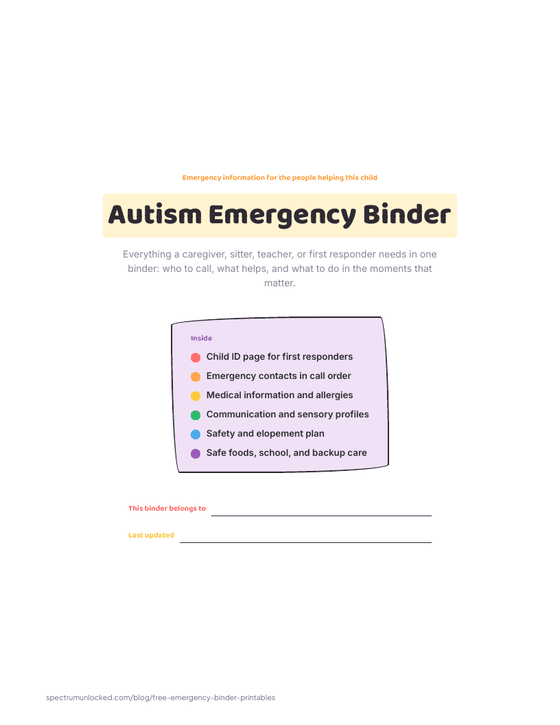
Crayon World
Sunshine, bunting, and sketch-book energy. Matches the All About Me packet.
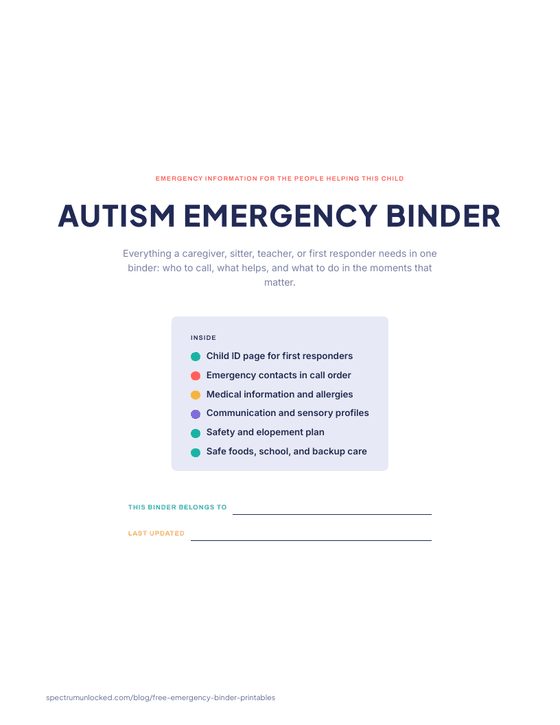
Space Explorer
Mission-console framing, toner-friendly. For the kid who runs on rockets.
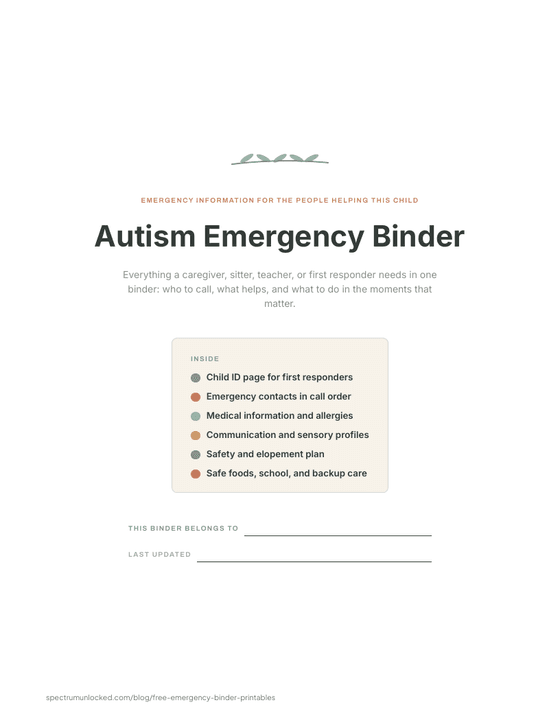
Calm
Muted sage and terracotta, clean type. Matches the teacher planner.
Free for home, school, and clinic use. No email needed, ever.
Behavior is communication. The question is what it's telling you.
Beacon learns about YOUR child and gives guidance specific to them.
What would Beacon say?
"Help me understand what's driving this behavior"
Beacon helps you map the trigger and the function, then plan a response that meets the same need, tailored to your specific child instead of a generic chart.

Spectrum Unlocked Editorial Team
Editorial Team
The Spectrum Unlocked editorial team combines lived experience as autism parents with research-backed guidance to create resources families can trust.
Frequently asked questions
- What should be in an emergency binder for an autistic child?
- Everything a stranger would need to keep your child safe and calm if you were not there: identification with a current photo, emergency contacts in calling order, medications and allergies, how your child communicates and how to communicate back, sensory triggers and what actually helps, elopement history and where they are drawn to go, safe foods and foods they will refuse, the school and therapy schedule, and the plan for who takes over if you cannot be reached. This pack has one page for each.
- How is this different from a family emergency binder?
- General family emergency binders organize documents: insurance, finances, house information. They assume everyone in the family can answer questions, follow instructions from a stranger, and eat what they are handed. For an autistic child none of that is guaranteed, so this binder leads with the pages a general template does not have: communication, sensory regulation, elopement risk, and safe foods. Families who want the document-organizer kind as well can use both together.
- Are these emergency binder printables really free?
- Every file is free with no email required: three complete designs, each in US Letter and A4, plus a fillable PDF version of each design you can type into before printing, and an editable PowerPoint version where every card, line, and label is a real object. Print the design your family likes; the pages are the same.
- Who should get a copy of the binder?
- The binder on your shelf is the master copy. Beyond that, think about who would actually be with your child in an emergency: the backup caregiver named on the last page, grandparents or a regular sitter, and the school or therapy clinic, which often only holds medical forms and has nothing about communication or de-escalation. Some families also keep a copy in the car.
- Can I type into the binder instead of writing by hand?
- Yes. Each design has a fillable PDF with a type-in field on every write line, so you can complete it on a laptop and print, and an editable PowerPoint if you want to change the pages themselves: add rows, remove a section, or translate labels. The standard PowerPoint edition uses fonts that ship with PowerPoint, and a designer-fonts edition matches the printed PDF exactly with free Google Fonts.
- How often should I update an emergency binder?
- After any change to medications, school, therapy schedule, or contacts, and at least once a school year even if nothing obvious changed. An out-of-date binder can be worse than none, because responders will trust what it says. The last page has a review log with a date column so you can see at a glance when it was last checked, and the fillable PDF makes re-printing a single page painless.