Special Education Lesson Plans: A Weekly System for a Mixed-Goal Room
How to plan for a room where every student has a different IEP goal: what belongs on the page, a weekly workflow that takes about forty minutes, and thirty finished plans you can open and copy.
Key Takeaways
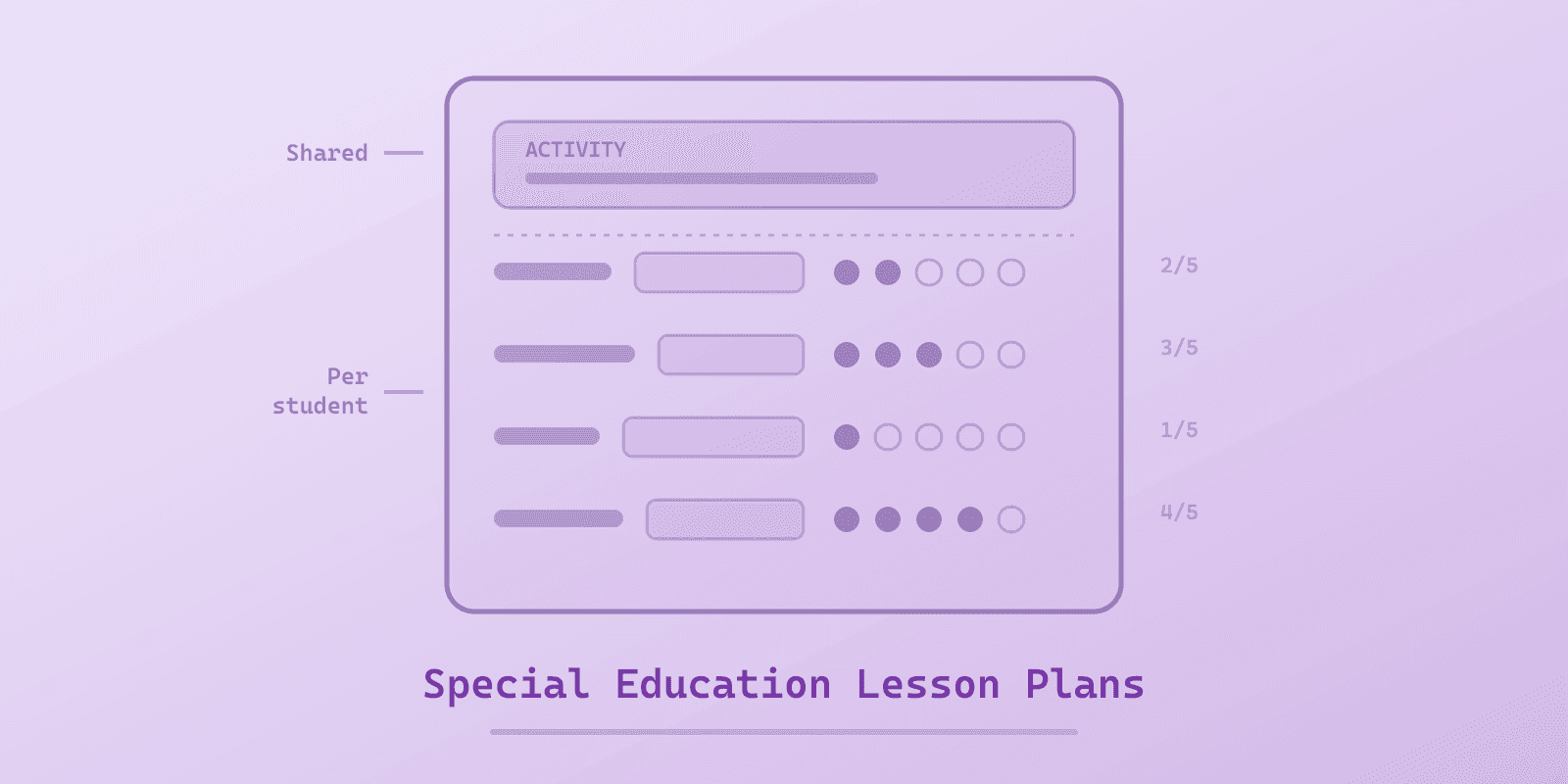
- Plan the activity once and the targets per student. In a mixed-goal room the activity is shared and the objective is not, so a plan with one objective line at the top will always be wrong for somebody in the group.
- A special education lesson plan needs six things general education plans do not always carry: the IEP goal each student is working, the prompt level you will start at, the materials already prepared, what the other adults do, how you score it, and what happens if a student refuses.
- Batch planning weekly, not daily. Writing one plan per activity block and reusing it across the week takes roughly forty minutes and beats rewriting a plan every night.
- Repetition is instruction, not laziness. Students working on generalization need the same lesson across several days with the materials changed, so a plan that gets reused four times is doing its job.
- Write the objective so the plan doubles as the data sheet. If the objective says four of five trials at a stated prompt level, the scoring column is already designed and progress monitoring stops being a second task.
Most lesson plan formats assume one room, one objective, one measure of whether it worked. That assumption holds until you are running a small group where one student is working on requesting with a core board, one is working on waiting for a turn, and one is counting the spaces they move on the board. The activity is shared. The objective is not, and no amount of formatting fixes a template that only has room for one.
That is the actual planning problem in special education, and it is why plans borrowed from a general education binder tend to get abandoned by October.
The short version
A special education lesson plan works when it separates what everyone does from what each student is learning:
- Pick one activity the whole group can access. The activity is the container, not the objective.
- Write a target per student underneath it, tied to that student's IEP goal.
- Name the starting prompt level for each student, so any adult can run it the same way.
- List the materials that must exist before the lesson starts, because a prepared bin is what makes the plan reusable.
- Say what the other adults do. In a room with two to four staff, an unassigned adult is a wasted one.
- Score on the plan itself, so the lesson and the data are one page rather than two tasks.
Everything after this section is detail on those six, plus the finished examples.
Why the usual template fails
A general education plan has an objective line near the top. It reads something like: students will identify coins to twenty-five cents with eighty percent accuracy. In a class of twenty-eight working toward the same standard, that line is true for nearly everyone.
Put four students with individual IEP goals in front of it and the line is wrong for at least three of them. So teachers do one of two things. Some write four separate plans, which is unsustainable by the second week. Others write one plan and hold the differences in their head, which works until a substitute arrives, or until a progress report is due and the data was never recorded against anybody's goal.
The fix is structural rather than a matter of effort. The activity belongs at the top and the objectives belong in rows.
What belongs on the page
Six things earn their space on a special education plan, and general education formats often carry none of them.
The IEP goal each student is working. Not the whole goal text, just enough to identify it. Writing it on the plan is what connects Tuesday morning to the annual review.
This lesson's target. The goal is the year. The target is today. A student whose goal is requesting across three settings has a target this morning of four requests during snack.
The prompt level you start at. This is the difference between a plan two adults run identically and a plan that produces two different sets of data. Independent, gestural, verbal, and physical are the usual rungs. Name the one you begin with, and expect it to fade over the weeks.
Materials, listed before the lesson. Plans die on missing materials. A plan that says "counting bears, number cards to twenty, one work mat per student" can be handed to a paraprofessional at eight in the morning.
Adult roles. In a self-contained room the plan should say who leads, who is scoring, and who handles a student leaving the group. If you have not written it down, it is being improvised, and it will be improvised differently every day.
A refusal plan. Something will go sideways. Deciding in advance what happens when a student pushes the materials away is far better than deciding it in the moment in front of the group.
A weekly workflow that takes about forty minutes
The teachers who lose whole evenings to planning are almost always writing from a blank page. Batching removes most of that.
- Plan per activity block, not per day. Morning circle, reading group, math group, and the life skills block each need a plan. That is four plans, not twenty.
- Write Sunday or Friday, once. Pick a fixed slot and protect it. Planning that floats gets done at eleven at night.
- Reuse each plan across the week, changing the materials. Same structure, different bears, different coins, different book.
- Fade prompts rather than rewriting. The plan stays; the prompt column moves from physical toward independent as the week goes on.
- Copy last week rather than starting blank. Editing takes minutes. Composing takes an hour.
Reuse is worth defending, because it gets mistaken for cutting corners. Students working toward mastery need repetition, and students who have mastered a skill in one setting need it practiced in others before it generalizes. A lesson that runs four times with the materials swapped is doing the thing the IEP asked for.
Eight kinds of plan, and the one you actually need
"Lesson plan" covers several different documents in a special education building, and the wrong shape is a common reason planning feels harder than it should. Each of the finished plans below is a real page you can open, read, and copy, with the differentiation and scoring already filled in.
Core instruction. The standard special education lesson plan carries one activity and per-student targets. Worked versions include a visual recipe for a snack, requesting with a core board, a turn-taking game, naming emotions with a feelings chart, a six step hand washing routine, next dollar up at a class store, the five senses, what friends do, telling time to the hour, the first ten sight words, counting and matching, and comparing two groups in kindergarten math. The Lesson Plan pack collects the blank in every design with worked examples and a teacher guide, and there is a free sample if you want to print one before deciding.
Small group. A small group plan is narrower and adds a rotation. See a decoding group, numbers to twenty, and asking for help the first time. The Small Group pack carries the same plan across the designs, with a free sample to try first.
Reading group. Guided reading in a special education room needs a place to record what the reader actually did with the text, which is why these carry a running record rather than a comprehension box. Compare a decoding intervention with a kindergarten guided reading group. The Reading Group pack includes the running record as its own sheet, and there is a free sample.
Circle time and morning meeting. These are routines rather than lessons, so the plan is a sequence with participation targets. The free circle time sample is one complete plan in that shape if you want to see the participation targets written out before building your own. There is a preschool colors week, a self-contained morning circle built on a day board, a kindergarten morning meeting on taking turns, and an upper elementary meeting on disagreeing well. Both live as their own packs, Circle Time and Morning Meeting, each with a free sample (circle time, morning meeting).
Behavior plans. When the barrier is behavior rather than the academic target, the plan needs antecedents and a replacement skill instead of a lesson sequence. See flopping at transitions, refusing to start written work, and leaving the classroom. The Behavior Plan pack puts the antecedent and replacement columns on the page in every design, with a free sample.
Therapy sessions. A speech session plan scores trials rather than participation. There are worked examples for initial /r/ at word level, he and she in sentences, and requesting on a core board. The Speech Session pack is built around that trial grid, and has a free sample.
Sub plans. The one document that has to work without you. Start from sub plans for a self-contained classroom, keep an emergency folder that stays current all year, and use a long-term binder for planned leave. The Sub Plans pack collects all three shapes in one download, with a free sample to leave in the folder this week.
If none of the finished versions matches your group, the lesson plan maker builds one from your own goal and activity and gives you the printable and a type-in copy, in US Letter and A4, with nothing to sign up for.
Write the objective so it doubles as the data sheet
This is the highest-leverage habit in the whole system, and it costs nothing at planning time.
A vague target produces a plan you cannot score. "Student will participate in the counting activity" leaves you at the end of the lesson with a feeling rather than a number. A target written with a condition, a behavior, and a criterion designs its own scoring column: "given a field of two, will hand the correct number card in four of five trials with a gestural prompt."
Now the plan has five circles next to that student's row and you already know what to write in them. Progress monitoring stops being a separate evening job, which is usually where it quietly gets dropped. If your goals themselves need work first, writing measurable IEP goals is the piece to read before the planning changes will help.
Differentiate without writing four plans
Three levers cover most of what a mixed group needs, and none of them require a second document.
Change the response, not the activity. One student says the answer, one points, one hands a card, one selects on a device. Same question, four access points.
Change the field size. A field of two is a different task from a field of eight. Moving a student from two to four is a real step and it fits in one column of the plan.
Change the prompt, not the target. Two students can both be working on the same skill with one at physical prompting and one at independent. That is one row of difference, not one plan of difference.
The classroom visual supports already in the room usually carry more of this than teachers expect, because a schedule strip or a choice board is an access point as much as a regulation tool.
Mistakes that cost the most time
Planning daily instead of weekly. The single largest time sink, and the easiest to fix.
Writing the plan for the binder rather than the room. A plan written to be checked by an administrator and a plan a paraprofessional can run at nine in the morning are different documents. Write the second one and it will satisfy the first.
Leaving the adults out. If the plan does not say what the second adult is doing, the second adult will find something to do, and it will not be the thing you needed.
Keeping data somewhere else. Every separate data system is one more thing to maintain in a week that has no slack in it.
Starting from blank every time. Almost nothing in a special education room is genuinely new each week. The structure repeats even when the content changes, and the structure is the part that takes the time to write.
Where to start this week
Pick one activity block, not the whole schedule. Write a single plan for it with a target row per student and a scoring column, run it four days with the materials changed, and see whether Friday's progress notes were easier to write than last week's. If they were, do the second block next week.
For the room around the plans, setting up a self-contained classroom covers the zones and the visual systems these lessons run inside.
Writing goals for a caseload, not for one child.
Beacon remembers your students and your setting, so you are not re-explaining them every time.
What would Beacon say?
"Help me write measurable goals from these present levels"
Beacon turns what you have written about a student into goals with baselines and criteria already attached, in the wording your district expects to see.

Spectrum Unlocked Editorial Team
Editorial Team
The Spectrum Unlocked editorial team combines lived experience as autism parents with research-backed guidance to create resources families can trust.
Frequently asked questions
- What should a special education lesson plan include?
- It needs the shared activity, then a per-student row carrying that student's IEP goal, the target for this lesson, the prompt level you will start at, and space to score. Beyond that, list the materials that must be prepared in advance, what each adult in the room is doing during the activity, how you will record the result, and a written plan for refusal or escalation. General education plan formats usually carry one objective for the whole class, which is the single thing that makes them fail in a mixed-goal room.
- How do you write a lesson plan for students with different IEP goals?
- Separate the activity from the objective. Choose one activity the whole group can access, then write a different target for each student underneath it. One small group playing a turn-taking game can have a student working on requesting with a core board, another on waiting, and a third on counting the spaces they move, all inside the same ten minutes. Write each student's target in their own row so the plan tells you what to watch for, and score each row separately.
- How long should special education lesson planning take?
- About forty minutes a week once the plans exist in a reusable form. Plan per activity block rather than per day, reuse each plan across several days with the materials swapped, and keep a folder of finished plans you can copy. The teachers who spend hours on this are usually rewriting from a blank page every time instead of editing last week's.
- Can you reuse the same lesson plan more than once?
- Yes, and for many students you should. Skills that appear in an IEP usually need repetition to reach mastery and then need to be practiced in different contexts before they generalize. Running the same lesson four days in a row with a different set of materials each day is a deliberate teaching decision. What should change across those days is the prompt level, which fades as the student gets more independent.
- What is the difference between a lesson plan and an IEP goal?
- The IEP goal is the year-long target and the lesson plan is one step toward it. A goal might say a student will request preferred items using a core board across three settings with eighty percent accuracy. A lesson plan for Tuesday says that today, during snack, the student will make four requests using the core board with a gestural prompt. The lesson is where the goal actually gets taught, and the scoring column is what tells you whether the goal is moving.
- Do special education teachers have to write daily lesson plans?
- It depends on the district, and many require plans to be available rather than newly written each day. Where daily plans are required, a reusable plan with the date and the materials updated normally satisfies it. The useful question to ask an administrator is what they need to see, because a plan written to be checked and a plan written to be run by a paraprofessional at nine in the morning look different, and only the second one helps you teach.